
Secondary School Ranking 2023 Singapore: PSLE Cut-Off Points
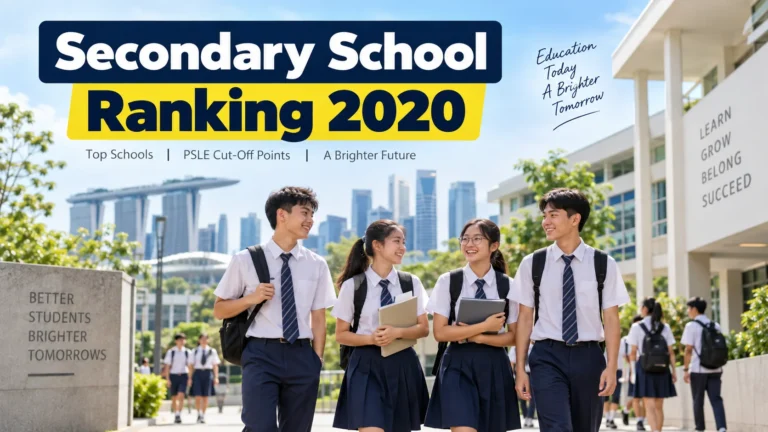
Choosing a secondary school is an important decision for families in Singapore. Many parents search for secondary school ranking 2023 to compare popular schools, understand historical PSLE cut-off points, and explore suitable options for their children.
This guide looks at admission competitiveness for the 2023 Secondary 1 intake, explains how cut-off points work, and offers practical advice on choosing a school.
However, rankings based on admission scores are not an official measure of overall school quality. A school’s programmes, culture, location, and learning environment also matter. Use this historical information as a starting point, not the only factor in your decision.
What Does Secondary School Ranking 2023 Mean?
A school ranking can be a useful starting point, but it cannot tell you everything about a school. In Singapore, many websites create their own rankings using PSLE Achievement Level (AL) cut-off points. These lists show how competitive admission was, rather than providing an official MOE ranking of school quality.

A cut-off point is the score of the last student admitted through a particular posting exercise. It can change from year to year, so a historical score should be treated as a guide, not a guaranteed entry requirement.
There is also an important difference between the examination year and the admission year. Students who took the PSLE in 2022 entered Secondary 1 in 2023, while the 2023 PSLE cohort entered in 2024.
This article focuses on the 2023 Secondary 1 intake. It uses historical admission information to help readers understand school competitiveness while keeping the wider school-choice decision in perspective.
Secondary School Ranking 2023: Top Schools in Singapore
The secondary school ranking 2023 below highlights selected schools that were highly competitive for the 2023 Secondary 1 intake. It uses historical PSLE Achievement Level (AL) cut-off points to provide a snapshot of admission demand. These figures are useful for comparison, but they should not be treated as a current admission guide or an official ranking of school quality.
| School | Programme | Historical AL Cut-Off |
| Raffles Girls’ School (Secondary) | IP | 6 |
| Raffles Institution | IP | 6 |
| Methodist Girls’ School (Secondary) | IB | 6 |
| Nanyang Girls’ High School | IP / SAP | 7(D) |
| Hwa Chong Institution | IP / SAP | 7(M) |
| CHIJ St. Nicholas Girls’ School | IP / SAP | 7(M) |
| Anglo-Chinese School (Independent) | IB | 7 |
| National Junior College | IP | 7 |
| Catholic High School | IP / SAP | 8(M) |
| Dunman High School | IP / SAP | 8(M) |
A lower cut-off point generally shows that admission was more competitive in that particular exercise. It does not mean a school is automatically better than one with a higher score. Schools differ in their programmes, teaching approaches, co-curricular activities, and learning environments. A student’s interests and needs should therefore remain part of the decision.
The figures above are historical references for the 2023 Secondary 1 intake, based on a published third-party ranking. They should not be confused with the 2023 PSLE cohort, which entered secondary school in 2024. Before making a current school choice, families should check the latest official admission information and school profiles. Historical rankings are most useful when they help narrow a shortlist, rather than decide the final choice.
How PSLE AL Cut-Off Points Work
The PSLE Achievement Level (AL) system uses a total score from 4 to 32, with lower scores representing stronger performance.
A school’s cut-off point is the score of the last student admitted in a particular posting exercise. It depends on student results, available places, and school choices.
Because these factors change each year, a previous cut-off point does not guarantee admission. Families should use historical scores as a guide and check the latest official information before choosing schools.
IP, IB and O-Level Pathways Explained
Singapore secondary schools offer different pathways, so it is useful to understand what each one involves before comparing schools. The right choice depends on a student’s learning style, interests, and future plans.
Integrated Programme (IP)
The Integrated Programme is generally a six-year pathway leading to a pre-university qualification without taking the Singapore-Cambridge GCE O-Level examination at Secondary 4. It may suit students who are comfortable with a longer academic programme and enjoy exploring subjects in greater depth.
International Baccalaureate (IB)
Some schools offer a pathway leading to the IB Diploma. The programme includes a broad range of subjects and different assessment requirements. It may appeal to students who enjoy independent learning, research, and studying across several subject areas.
O-Level Pathway
The traditional O-Level pathway allows students to complete secondary education before choosing a post-secondary route, such as junior college or polytechnic, depending on their results and interests. It may suit students who prefer a more familiar examination-based route and want to keep different options open.
No pathway is automatically better. Families should compare the curriculum, school environment, and student’s strengths before deciding.
How to Choose the Right Secondary School
A good school choice is about more than PSLE scores. Parents should consider whether the school’s culture, subjects, and learning environment suit their child’s interests and needs.
Look at the CCAs available, the support students receive, and the travelling distance from home. A manageable commute and a comfortable school environment can make everyday school life easier.
To build a balanced shortlist, compare schools across different historical score ranges. Visit open houses where possible, explore their programmes, and discuss the options with your child. The goal is to find a school where they can learn, grow, and feel supported—not simply the one with the lowest cut-off point.
2023 PSLE Results vs 2024 Secondary 1 Intake
The year in a school ranking can be confusing. Students who took the PSLE in 2023 entered Secondary 1 in 2024, while the 2023 Secondary 1 intake was based on the previous year’s PSLE results.
This means a ranking labelled “2023” may refer to a different admission exercise from a list of 2023 PSLE cut-off points. Always check the intake year before comparing schools.
Historical cut-off points are useful for understanding past admission patterns, but they should not be mixed with current figures. For a new application, check the latest official school information and admission guidance.

Frequently Asked Questions
Is there an official secondary school ranking in Singapore?
No. Online rankings are usually third-party comparisons based on PSLE cut-off points, not official MOE rankings of school quality.
What does a lower AL cut-off point mean?
It generally means admission was more competitive for that intake. It does not automatically mean the school is better.
Are 2023 cut-off points still useful?
Yes, as historical references. Use the latest official information for current school choices.
Is admission guaranteed if I meet the cut-off?
No. Cut-off points can change each year, so meeting a previous score does not guarantee admission.
What is the difference between IP and O-Level schools?
IP generally offers a six-year pathway without the Secondary 4 O-Level examination. The traditional O-Level pathway includes that examination.
Should I choose a school only by ranking?
No. Consider school culture, subjects, CCAs, travelling distance, and your child’s learning needs.
Where can I check official school information?
Use MOE SchoolFinder for school profiles and programmes, and check the latest official admission guidance.
Final Thoughts
The secondary school ranking 2023 can help families understand historical admission competitiveness, but it should not be the only factor in choosing a school. Cut-off points may change each year, and a lower score does not automatically mean a school is the best fit for every student.
Consider your child’s interests, learning needs, school culture, programmes, and travelling distance when comparing options. A balanced shortlist can help you make a more informed decision. Before submitting school choices, check the latest official admission information through MOE SchoolFinder.