Tiong Bahru Singapore 2026: Food, Cafés & Things to Do
Tiong Bahru Singapore is one of the city’s most distinctive neighbourhoods, known for its Art Deco architecture, traditional food market, independent cafés, bookstores and peaceful residential streets.
Located just outside Singapore’s central business district, Tiong Bahru combines old neighbourhood charm with modern café culture. Visitors can explore historic housing blocks, enjoy local breakfast dishes, discover small shops and experience a quieter side of Singapore.
Unlike Orchard Road or Marina Bay, Tiong Bahru is not built around major tourist attractions. Its appeal comes from everyday neighbourhood life, architecture and food.
Tiong Bahru at a Glance
| Detail | Information |
|---|---|
| Location | Central Singapore, near Outram |
| Nearest MRT | Tiong Bahru MRT (EW17) |
| Famous For | Art Deco housing, cafés, heritage and local food |
| Main Food Destination | Tiong Bahru Market |
| Best Time to Visit | Morning to early afternoon |
| Recommended Duration | 2–4 hours |
| Entry Fee | Free to explore |
| Nearby Areas | Outram Park, Chinatown, River Valley |
Where Is Tiong Bahru?
Tiong Bahru is a residential neighbourhood located southwest of Singapore’s city centre.
It sits near Outram Park, Chinatown and the Singapore River area.
The neighbourhood is particularly famous for its low-rise pre-war apartment buildings, which contrast with the tall residential towers found across much of Singapore.
Its compact layout makes walking one of the best ways to explore.
Why Is Tiong Bahru Famous?
Tiong Bahru is famous for being home to one of Singapore’s earliest public housing estates.
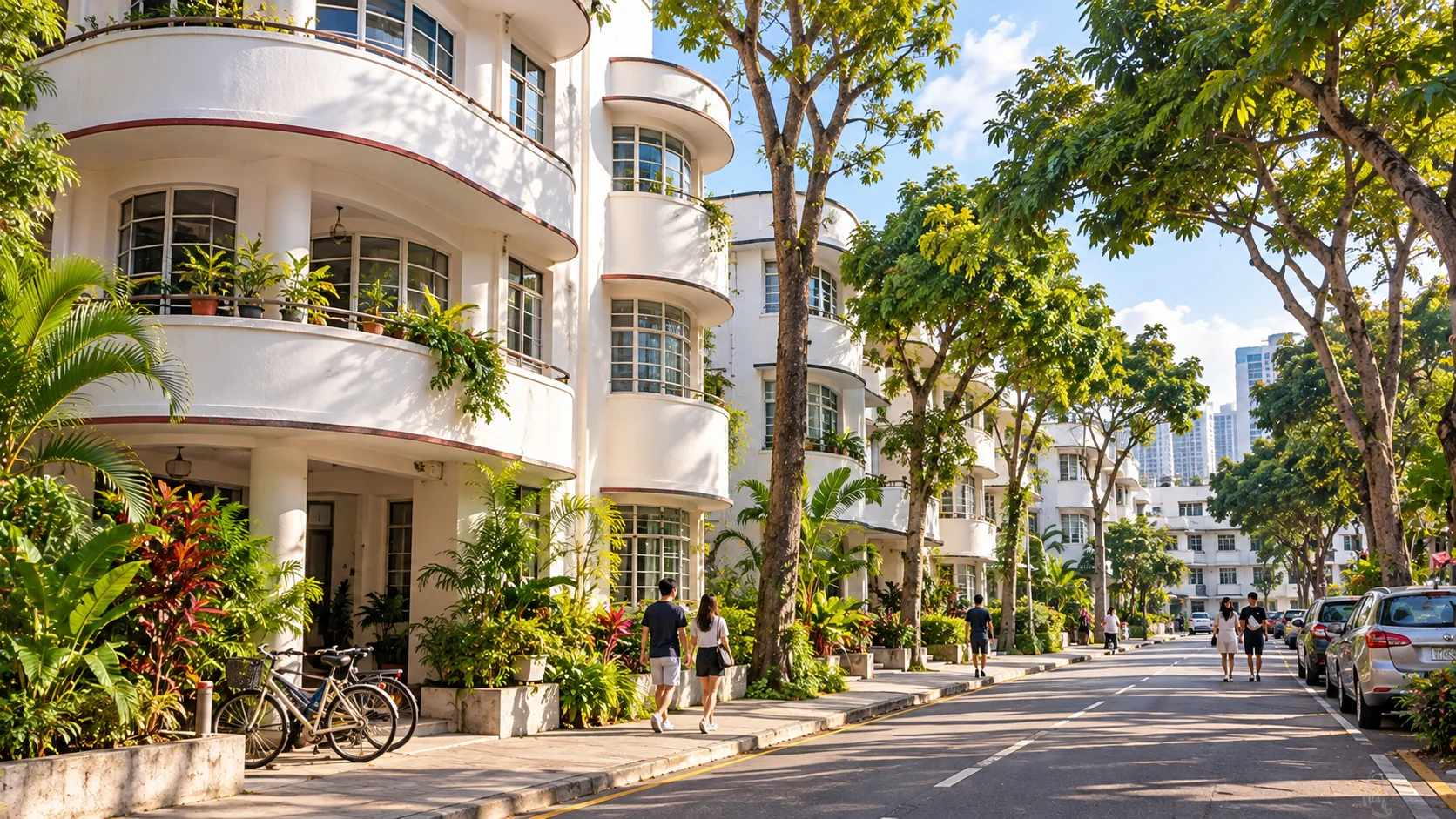
Many of its pre-war residential buildings were constructed during the 1930s and feature curved balconies, rounded corners, horizontal lines and other Art Deco and Streamline Moderne influences.
Today, the neighbourhood is also known for its independent businesses.
Traditional food stalls operate alongside bakeries, coffee shops, bookstores and small lifestyle retailers.
This mix of old and new gives Tiong Bahru its distinctive character.
The History of Tiong Bahru
Tiong Bahru’s name reflects the area’s earlier landscape.
The word tiong is associated with graves in Hokkien, while bahru means new in Malay. The name is commonly interpreted as “new cemetery.”
Before residential development, parts of the area were associated with burial grounds.
During the 1930s, the Singapore Improvement Trust developed housing in Tiong Bahru.
These apartments represented an important stage in Singapore’s urban housing history.
After the Second World War, additional residential blocks were developed nearby.
Today, the pre-war estate remains an important example of Singapore’s architectural heritage.
Explore Tiong Bahru’s Art Deco Architecture
One of the best activities in Tiong Bahru is simply walking around its historic streets.
Many buildings feature smooth white façades, rounded balconies and distinctive geometric shapes.
The architecture looks noticeably different from modern Housing & Development Board estates.
Some buildings have curved stairwells and long horizontal windows that reflect design trends from the early twentieth century.
Visitors interested in architecture should explore the streets around Yong Siak Street, Eng Hoon Street and Moh Guan Terrace.
Remember that these are residential buildings, so avoid entering private areas or disturbing residents.
Visit Tiong Bahru Market and Food Centre

Tiong Bahru Market is one of the neighbourhood’s main attractions.
Located at 30 Seng Poh Road, the building houses a traditional wet market and a popular hawker food centre.
The wet market is where residents purchase fresh vegetables, seafood, meat and other ingredients. The food centre upstairs serves a selection of traditional Singapore dishes.
It is an excellent place to begin exploring the neighbourhood because you can enjoy breakfast before walking around the heritage estate.
The market is also the starting point of the official Tiong Bahru Heritage Trail.
Best Food to Try in Tiong Bahru
Tiong Bahru is particularly popular with food lovers.
The neighbourhood has both traditional hawker food and contemporary cafés, making it suitable for different tastes and budgets.
Chwee Kueh
Chwee kueh is a traditional Singapore breakfast dish made from steamed rice cakes.
The cakes are topped with preserved radish and usually served with chilli.
It is a good choice for visitors who want to try something local rather than a typical Western breakfast.
Lor Mee
Lor mee features noodles served in a thick, savoury gravy.
Depending on the stall, toppings may include braised meat, egg, fish or fried ingredients.
The rich gravy makes it a filling breakfast or lunch option.
Hokkien Mee
Singapore-style Hokkien mee typically combines yellow noodles and rice vermicelli with a seafood-based stock.
Prawns, squid and egg are common ingredients.
A squeeze of lime and chilli can add extra flavour.
Kaya Toast and Kopi
For a lighter breakfast, try kaya toast with soft-boiled eggs and local coffee.
Kaya is a sweet coconut-and-egg jam commonly served with butter between slices of toast.
This is a familiar breakfast combination across Singapore.
The National Heritage Board identifies dishes including chwee kueh, Hokkien prawn noodles, lor mee and traditional snacks as part of Tiong Bahru’s hawker-food heritage.
Discover the Cafés of Tiong Bahru
Tiong Bahru has developed a reputation for its café culture.
Small coffee shops and bakeries operate within the historic neighbourhood, often occupying ground-floor spaces beneath older apartment buildings.
These establishments create an interesting contrast between contemporary interiors and traditional architecture.
Visitors can enjoy coffee, pastries, breakfast dishes or light lunches before continuing their walk.
Yong Siak Street and Eng Hoon Street are useful starting points for exploring the café scene.
Since individual businesses and opening hours change, check the latest details before travelling to a particular café.
Explore Yong Siak Street
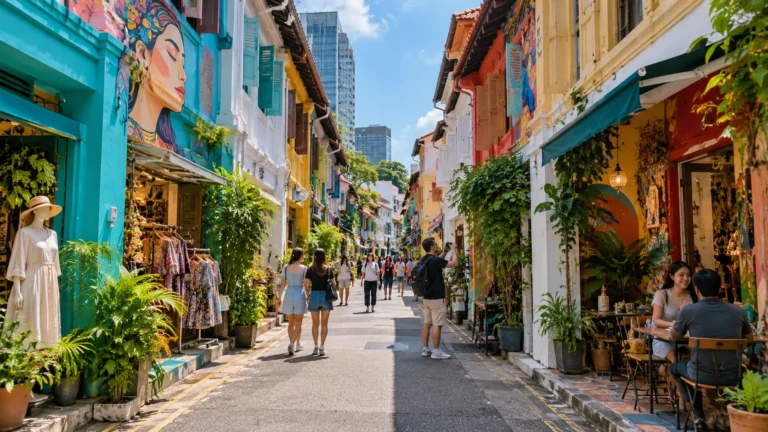
Yong Siak Street is one of the neighbourhood’s most interesting streets for visitors.
It combines historic residential buildings with independent shops, cafés and small lifestyle businesses.
Unlike large shopping districts, the street feels relaxed and compact.
You can browse bookstores, explore small retailers or stop for coffee without walking long distances.
It is also a good location for photographing Tiong Bahru’s characteristic architecture.
Follow the Tiong Bahru Heritage Trail
Visitors interested in local history should consider the official Tiong Bahru Heritage Trail.
Developed by Singapore’s National Heritage Board, this self-guided trail introduces the estate’s architecture, cultural landmarks and community history.
The trail includes ten principal heritage locations, covering sites such as the former Bird Corner, Monkey God Temple, Seng Poh Garden and the distinctive Horseshoe Block.
You can follow the route independently rather than joining a scheduled tour.
The official trail details are available on
See the Famous Horseshoe Block
One of the most distinctive architectural features in Tiong Bahru is the Horseshoe Block.
Located around Moh Guan Terrace and Guan Chuan Street, the curved residential block was constructed between 1939 and 1940.
Its unusual shape reflects the estate’s modernist architectural design.
The building is also associated with a pre-war civilian air-raid shelter, although the shelter is not generally open for casual public access.
Visitors can appreciate the exterior architecture while respecting the privacy of residents.
Visit the Monkey God Temple
Tiong Bahru Qi Tian Gong, commonly called the Monkey God Temple, is another historic landmark.
The temple is associated with worship of the Monkey God and has roots dating back to 1920.
It provides an interesting cultural stop between the estate’s residential streets and food businesses.
Visitors should dress respectfully and avoid disturbing worshippers.
The temple is included in the official heritage trail
Relax at Seng Poh Garden
Seng Poh Garden offers a quieter space within the historic estate.
It is known for its greenery and the Dancing Girl sculpture, which forms part of the neighbourhood’s heritage landscape.
The garden is a useful place to rest during a walking tour.
It also reflects the original planning of Tiong Bahru, where open spaces were integrated among residential buildings.
Photography in Tiong Bahru

Tiong Bahru is an attractive neighbourhood for architectural photography.
The low-rise buildings, curved balconies and tree-lined streets create compositions that look different from Singapore’s modern skyline.
Early morning is a good time for photographs because the streets may be quieter and the light softer.
Look for geometric patterns, staircases, windows and curved building corners.
Avoid photographing directly into private homes or blocking residential entrances.
Best Time to Visit Tiong Bahru
The best time depends on your interests.
| Time | Recommended Activity | Experience |
|---|---|---|
| 7 AM–9 AM | Local breakfast | Morning market and hawker atmosphere |
| 9 AM–11 AM | Heritage walking | Comfortable time for outdoor exploration |
| 11 AM–1 PM | Cafés and shops | More independent businesses may be open |
| 1 PM–4 PM | Shopping and coffee | Warmer weather; useful for indoor stops |
| 4 PM–6 PM | Photography | Softer afternoon light |
| Evening | Dinner and neighbourhood walks | Quieter residential atmosphere |
For first-time visitors, arriving in the morning is a good option.
You can begin with breakfast and explore the historic estate before the afternoon heat becomes uncomfortable.
How to Get to Tiong Bahru by MRT
Tiong Bahru MRT Station is on Singapore’s East West Line.
From the station, the historic neighbourhood and Tiong Bahru Market can be reached on foot.
The walk to the market is approximately 10–15 minutes, depending on your route and walking pace.
Outram Park MRT is another option for visitors approaching the eastern side of the neighbourhood.
Check the latest public transport information through the
Land Transport Authority
Is Tiong Bahru Worth Visiting?
Tiong Bahru is worth visiting if you enjoy local food, architecture, photography and exploring neighbourhoods.
It offers a different experience from Singapore’s major attractions.
There are no large theme parks or spectacular observation decks in the historic estate.
Instead, visitors can enjoy a traditional breakfast, explore architectural landmarks and experience a neighbourhood where people live and work.
It is especially suitable for travellers who have already visited Singapore’s best-known landmarks and want something different.
Suggested Half-Day Tiong Bahru Itinerary
Begin your visit with breakfast at Tiong Bahru Market.
After eating, explore the nearby streets and photograph the Art Deco apartment buildings.
Continue towards the Horseshoe Block and other landmarks along the heritage trail.
Visit Yong Siak Street to browse independent shops and stop for coffee.
Finish with a relaxed walk through Seng Poh Garden or another part of the historic estate.
This itinerary provides a mix of food, architecture and local culture without requiring a full day.
Tiong Bahru in 2026
Tiong Bahru continues to attract attention for its architectural and cultural heritage.
In March 2026, Singapore’s National Heritage Board announced plans for a new Heritage Activation Node in Tiong Bahru, working with the local community centre.
The initiative is intended to celebrate the neighbourhood’s public housing architecture, longstanding religious sites, heritage businesses and lesser-known histories through community activities.
It reflects the continuing importance of Tiong Bahru as a living heritage neighbourhood rather than simply a tourist attraction.
Frequently Asked Questions
1. What is Tiong Bahru Singapore famous for?
Tiong Bahru is famous for its Art Deco housing, traditional hawker food, independent cafés, heritage streets and local history.
2. Which MRT station is nearest to Tiong Bahru?
Tiong Bahru MRT Station (EW17) on the East West Line is the main station serving the neighbourhood.
3. What food should I try at Tiong Bahru Market?
Popular options include chwee kueh, lor mee, Hokkien mee, traditional noodles and local breakfast dishes.
4. Is Tiong Bahru free to visit?
Yes. Exploring the neighbourhood, admiring its architecture and following the public heritage trail are free.
5. How long should I spend in Tiong Bahru?
Allow two to four hours for breakfast, architecture, cafés and a relaxed walk around the historic estate.
6. What is the best time to visit Tiong Bahru?
Morning is ideal for visiting the market, eating breakfast and exploring the streets before the afternoon heat.
7. Is Tiong Bahru worth visiting for tourists?
Yes. It is a good destination for travellers interested in Singapore’s heritage, local food, independent shops and neighbourhood life.
Final Thoughts
Tiong Bahru Singapore offers a refreshing contrast to the city’s skyscrapers, shopping malls and major tourist landmarks.
Its historic apartment buildings, traditional food centre, independent cafés and quiet streets create a neighbourhood that is enjoyable to explore at a slower pace.
Start with breakfast at Tiong Bahru Market, explore the Art Deco architecture and spend time discovering the smaller streets.
For visitors who want to experience Singapore beyond its famous attractions, Tiong Bahru is an excellent place to begin.