
PSLE Cut Off Point 2024: School Scores & Complete Guide
The Primary School Leaving Examination (PSLE) is one of the most important academic milestones for students in Singapore. After receiving their PSLE results, students and parents naturally start asking one major question: “Which secondary school can my child enter with this score?”
This is where the PSLE Cut Off Point (COP) becomes important.
The PSLE scoring system in Singapore uses Achievement Levels (ALs), where a lower total score generally indicates stronger performance. However, there is no single PSLE cut-off point for the whole country. Every secondary school can have a different score range depending on its popularity, available places, student choices and the overall performance of the cohort.
For parents researching PSLE Cut Off Point 2024, it is also important to understand the difference between the 2024 Secondary 1 intake and the 2024 PSLE score range. These terms are often used interchangeably online, even though they refer to different admission years.
What Is a PSLE Cut Off Point?
A school’s Cut-Off Point is essentially a reference based on the PSLE score of the last student admitted to that school in a particular posting exercise.
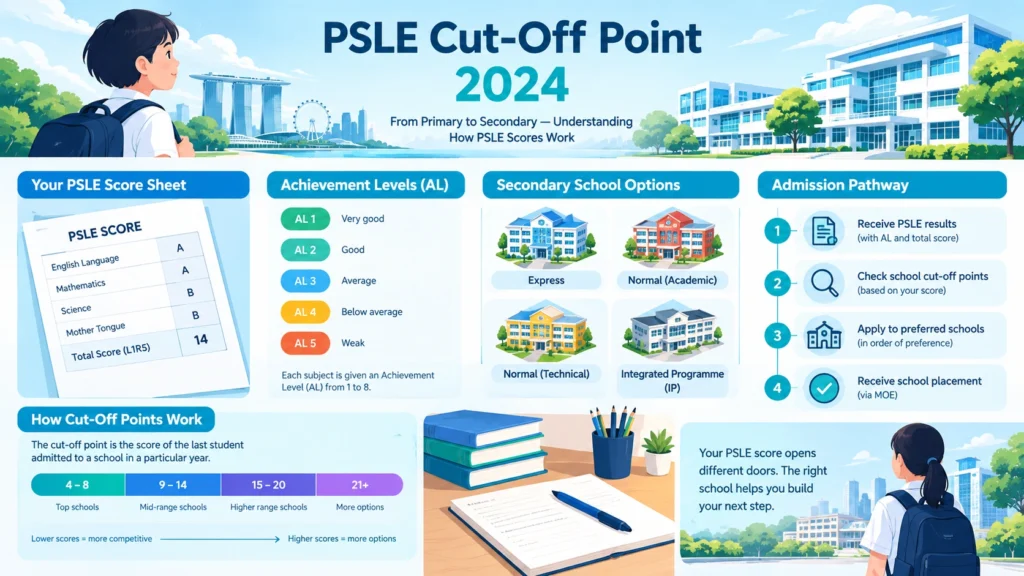
PSLE Cut-Off Point 2024 explained with Achievement Levels, school options and the secondary school admission pathway.For example, if a secondary school had a PSLE score range of 6–10, the higher end of that range indicates that the last student admitted had an AL score of around 10.
It is important to remember that a COP is not a fixed minimum entry requirement. It can move from one year to another depending on demand and the performance of students.
Singapore’s SEAB specifically advises students to treat previous schools’ COPs as a reference because they may vary according to the cohort’s PSLE results and school choices.
Understanding the 2024 PSLE Cut Off Point
The introduction of the Achievement Level system changed how parents compare secondary-school admission scores.
Instead of the old T-score system, students receive AL scores for individual PSLE subjects. Their four subject scores are added together to produce the overall PSLE Score.
Generally:
- Lower PSLE Score = stronger overall performance
- Higher PSLE Score = comparatively lower performance
- The best possible overall score is 4
- Schools with very competitive admission typically have lower COPs
For the 2024 PSLE cohort, 40,894 Primary 6 students sat for the examination, and SEAB reported that 98.5% were assessed as suitable for secondary school.
PSLE Cut-Off Point 2024: Selected Schools
The following table provides a useful snapshot of selected secondary schools and their 2024 PSLE score ranges. These figures should be viewed as historical admission references rather than guaranteed requirements.
| Secondary School | 2024 PSLE Score Range / COP | Programme |
| Raffles Institution | 4–6 | Integrated Programme |
| Raffles Girls’ School | 4–6 | Integrated Programme |
| Hwa Chong Institution | 4–6/7 | Integrated Programme |
| Nanyang Girls’ High School | 4–7 | Integrated Programme |
| National Junior College | Around 7 | Integrated Programme |
| Dunman High School | Around 7–8 | Integrated Programme |
| Victoria School | Around 8 | Integrated Programme |
| Cedar Girls’ Secondary School | Around 8 | Integrated Programme |
| CHIJ St. Nicholas Girls’ School | Around 8 | Integrated Programme |
| Methodist Girls’ School | Around 8 | Integrated Programme |
| Catholic High School | Around 8 | Integrated Programme |
| Anderson Secondary School | Around 10 | Mainstream |
| St. Joseph’s Institution | Around 9 | Mainstream/IP-related options |
| Temasek Secondary School | Around 9 | Mainstream |
| Nan Hua High School | Around 9 | Mainstream |
Published 2024 school score tables show that highly competitive IP schools generally had very low PSLE score ranges, while mainstream schools covered a much wider range.
Why Do PSLE Cut-Off Points Change Every Year?
One of the biggest mistakes parents make is assuming that a school’s previous COP will remain unchanged.
It does not.
A school’s cut off point can change because of several factors.
1. Student Demand
If more students with strong PSLE scores choose a particular school, competition becomes stronger. As a result, the final admitted score may become lower.
2. Number of Available Places
The number of students a school can accept also influences its final score range. A popular school with limited places can have a much more competitive COP.
3. Overall PSLE Performance
The performance of the entire cohort matters. If a larger number of students achieve strong scores, competition for highly sought-after schools may increase.
4. School Choices
The Secondary 1 posting process is influenced by the choices students submit. Therefore, changes in student preferences can affect the eventual COP.
This is exactly why SEAB recommends considering previous COPs as a guide rather than treating them as guaranteed admission scores.
What Are Posting Groups?
Another important part of understanding PSLE admission is the Posting Group system.
Under Full Subject-Based Banding, students are posted to secondary schools through Posting Groups rather than the former Express, Normal (Academic) and Normal (Technical) streams.
The three Posting Groups are:
- Posting Group 3 (PG3)
- Posting Group 2 (PG2)
- Posting Group 1 (PG1)
A student’s PSLE Achievement Level scores determine the Posting Group they are eligible for.
This means parents should not simply compare their child’s total PSLE score with one number. They should also check the relevant Posting Group and the school’s available programmes.
Affiliated vs Non-Affiliated Students
Some secondary schools have affiliated primary schools.
This can make a significant difference when looking at historical COP data.
An affiliated student may have a different admission range from a non-affiliated student, provided the relevant affiliation requirements are met.
For example, historical 2024 data shows different ranges for affiliated and non-affiliated students at several schools. Some schools also have Higher Chinese Language requirements or indicators attached to their score ranges.
Parents should therefore always check whether a published score applies to:
Affiliated students or non-affiliated students.
Comparing the wrong category can create unrealistic expectations.
What Do D, M and P Mean?
When researching PSLE school COP tables, you may come across letters such as D, M and P.
These can be associated with Higher Chinese Language performance in schools where such requirements or considerations apply.
In simplified terms:
- D = Distinction
- M = Merit
- P = Pass
For certain SAP or other schools, Higher Chinese Language performance can therefore be relevant when interpreting the published score range.
This is another reason why looking only at the numerical score may not tell the complete admission story.
Does a Good PSLE Score Guarantee Admission?
No.
A strong PSLE score improves a student’s chances, but it does not automatically guarantee admission to a particular school.
Suppose a school previously had a COP of 8. A student with a score of 8 may reasonably consider the school, but the result could be different in another year’s posting exercise.
The previous year’s COP is simply an indication of where the admission boundary landed.
In other words:
COP is a guide, not a promise.
This distinction is particularly important for parents making their school-choice list.
How Should Parents Use the 2024 COP?
The smartest approach is not to choose schools based on a single number.
Instead, parents should create a balanced list.
For example, if a student’s PSLE score is close to the historical COP of a highly competitive school, that school can be included as an ambitious choice. However, the remaining choices should include schools where the historical score range gives the student a more comfortable chance.
Parents should also consider:
- School culture
- Location and travelling time
- Academic programmes
- Co-Curricular Activities (CCAs)
- Subject offerings
- Integrated Programme availability
- Affiliation
- Student interests
- Support programmes
- School environment
SEAB itself encourages students to consider schools holistically rather than relying solely on previous COP figures.
2024 PSLE Cut-Off Point vs 2024 PSLE Score Range
This is one of the most confusing aspects of online PSLE information.
When someone searches for “PSLE Cut-Off Point 2024,” they may actually mean one of two things.
First: the COP used for the 2024 Secondary 1 intake, which was based on the previous PSLE cohort.

Second: the 2024 PSLE score ranges, which describe students admitted during the posting exercise following the 2024 PSLE results and therefore relate to the next intake.
For example, archived school data lists 2024 score ranges such as Anderson Secondary School at approximately 5–10 for PG3 non-affiliated students, while other schools had different ranges depending on their programme and Posting Group.
This distinction is essential when researching school admission statistics.
Frequently Asked Questions (FAQs)
1. What is the PSLE Cut-Off Point 2024?
It is the previous score range used as a reference for secondary school admission.
It helps parents understand how competitive a school may be.
2. Can the PSLE Cut-Off Point change?
Yes, the COP can change every year depending on demand and available places.
Previous scores should therefore only be used as a guide.
3. What is the lowest possible PSLE score?
The lowest possible PSLE Score is 4.
A lower total score generally means stronger performance.
4. Does the COP guarantee admission?
No, meeting the previous COP does not guarantee admission.
The actual score range can be different each year.
5. Do affiliated students have different COPs?
Yes, some schools may have different admission ranges for affiliated students.
The school’s specific admission requirements should always be checked.
6. What are PSLE Posting Groups?
PSLE students are placed into PG1, PG2 or PG3 based on their scores.
These groups are part of Singapore’s Full Subject-Based Banding system.
7. How should parents use the 2024 COP?
Parents should use the 2024 COP as a helpful historical reference.
They should also consider programmes, location and the child’s interests.
Final Thoughts
PSLE Cut-Off Point 2024 is a useful guide for comparing secondary schools, but it should not be treated as a guaranteed admission score. Parents should also consider the student’s PSLE score, Posting Group, interests, school programmes and overall suitability.
Ultimately, the best school is not always the one with the lowest COP, but the one that best matches the student’s abilities and goals.